
The best viewpoints of Tenerife: the island seen from above
Tenerife makes more sense from above. It is a vertical island that climbs from the sea to the 3,715 metres of Teide in just a few kilometres, and packed into that drop are cliffs, ravines, forests and villages you only truly appreciate when you look at them from a good balcony. Luckily, the island is full of them: viewpoints are among the best free views there are, and in many cases the spectacle is not the landscape but the clouds beneath your feet. Here are the best ones, arranged by area, so you can stop wherever you happen to be nearby.
The viewpoints of Tenerife by area
Not every viewpoint shows the same thing: some look out over the sea of clouds (mar de nubes), others towards Teide, others onto a cliff that takes your breath away. These are the essential ones, area by area.
Anaga: the green north and the sea of clouds
The Anaga massif, at the north-eastern tip, is a land of laurel forest, mist and hairpin bends. It is also the area where you are most likely to see the mar de nubes (sea of clouds), that white blanket trapped against the northern slope while the sun shines above.
The Mirador de Cruz del Carmen is the gateway: a visitor centre, laurel forest right beside it and, with luck, the clouds spilling over the La Laguna valley. A little further in, the Mirador Pico del Inglés offers one of the most complete panoramas on the island, with Teide in the background on clear days. And dropping back down towards La Laguna, the Jardina viewpoint gives you the classic view of the city and its plain. This is the area to take slowly, with a jacket to hand: Anaga is cool even when it is a stifling 25 degrees down below.
Teide and the summits: above the clouds
Climbing to the summits is like crossing to the other side of the sky. On the road up from La Orotava, the La Tarta viewpoint shows off the coloured layers of the volcanic terrain, like a many-layered cake. Higher up, the Chipeque and Ortuño viewpoints are famous for the sea of clouds at dusk: you sit above the cotton wool and watch the sun set over it.
Once inside the Parque Nacional del Teide, every bend is a viewpoint. The one at Narices del Teide, next to the last great lava flow, and the heights around Roque Cinchado put Teide front and centre. Here the light changes everything: at dawn and dusk the landscape turns red. Bring water and something warm, because at 2,000 metres the air is deceptive.
Teno and the west: cliffs and the Masca valley
The Teno massif, in the west, is the wildest. The Cherfe viewpoint opens up the view over the hamlet of Masca, wedged between mountains like a village from a fairy tale, and over the ravine that drops to the sea. Following the road of tight bends you reach Punta de Teno, the westernmost tip of the island, with its lighthouse, the Los Gigantes cliffs cut out to one side and La Gomera facing you. It is also one of the windiest spots: hold on to your hat.
The south and the valleys: long horizons
The south has less mist and more light. The La Centinela viewpoint, above the Valle de San Lorenzo, opens up a huge panorama of the southern coast and the volcanic cones, with a terrace where you can have a drink. In the Güímar valley, the Don Martín viewpoint shows the medianías (the mid-slopes) and the sea from another angle, more agricultural and calm. And in the north-west, the Garachico viewpoint gives you the postcard shot of the town and its islet, with the natural pool of El Caletón in the background.
How to make the most of the viewpoints
A couple of things that make the difference between a good view and a perfect one:
The sea of clouds keeps a schedule. It tends to form in the afternoon on the northern slope, pushed by the trade winds. To see it from above, aim for Anaga or the summits in mid-afternoon.
Get up early or stay for sunset. The light at the very start and end of the day is what turns an ordinary photo into one you want to frame. At midday there is often haze or backlight.
Wrap up even if it is hot down below. In Anaga and on the summits the temperature drops fast, and in Teno the wind cuts right through you.
Punta de Teno: leave the car behind. The access road, the TF-445, is closed every day to private cars, pedestrians and bicycles. You go up by bus from Buenavista del Norte, within a time window that changes with the season, or by taxi. Before you go, check the current rules on the Buenavista del Norte town council website, because the road can also be closed at short notice for works or weather alerts.
Getting there. Many viewpoints can be strung together by car on a single route (Anaga in one morning, the summits in another). Some are reachable by bus, but to really make the most of them it pays to go with time and a vehicle.
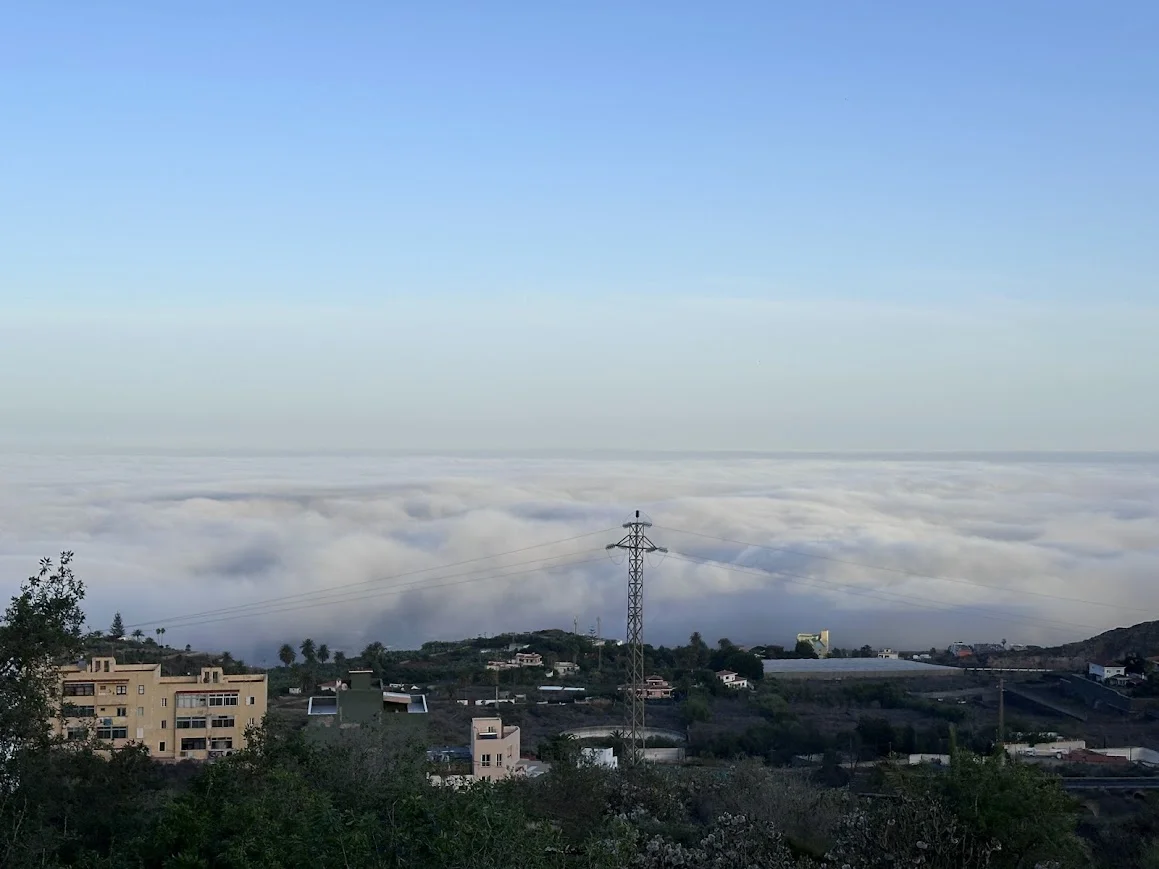
Our own photo, the mid-slopes of Icod.
Did you know? The famous Canary sea of clouds is no accident: the trade winds bring humid air from the Atlantic which, when it hits the mountains, gets trapped beneath a layer of warmer air (the so-called thermal inversion). That is why the north is green and cloudy while the south stays clear, and why from the high viewpoints it looks as though the clouds are below you. They actually are.
Choose your viewpoint
You do not need to see them all in one day, and you shouldn't. The lovely thing about the viewpoints of Tenerife is that each area tells a different island: Anaga the green one, the summits the lunar one, Teno the wild one, the south the luminous one. On islas24 you have the listings for the main ones, with location and how to get there, so you can build your own route. Pick an area, climb up without hurrying and let the island open out at your feet. To keep exploring, take a look at what to see in Tenerife, where you will find the places you cannot miss.
Before you head up: check the alert status
In summer, access to the summits, the forests and some mountain roads depends on the wildfire alert status. It is not fixed: it goes on and comes off with the conditions, sometimes from one day to the next, and on alert days there may be access controls, or bans on lighting fires and smoking in forest areas.
Two places to check before you set off:
The alert status is declared by the Canary Islands Government: Dirección General de Emergencias. The current declaration is on the front page.
The island's specific measures (which road, which park, what hours) are published by the Cabildo de Tenerife.

