
Canarian fiestas and romerías: what you have walked into, and what to do about it
An August evening, somewhere inland. The main street is closed off, there are rows of chairs in front of the church, and someone is testing the speakers. It smells of grilled meat and sugared almonds. In the middle of the square there is a long table that nobody has reserved.
You have no idea what you have walked into, and no idea whether you are allowed to join.
You are. That is the single most important thing to take from this article: a Canarian village fiesta is public, free, and needs no invitation. No ticket, no wristband, no such thing as "this one is for locals". You walk up, buy a beer at the stall, and watch. It works the same way on all eight islands, from the largest to the smallest.
What is true, though, is that what you see as a visitor is the top layer.
Because this is not a festival. A festival is organised by somebody, advertised, and taken down three days later. This is the village's own calendar, and it does not adjust to you. In Arafo, on Tenerife, the fiestas start in late July and end on 1 September: over a month of sports days, children's galas, processions and several nights of dancing. In Teguise, on Lanzarote, something happens every day for a week, from the afternoon craft workshop to the shared Sunday lunch. Dropping in for one weekend is like opening the door halfway through a long story.
It is still worth opening. You just want to know which chapter you are in.
Five words, and you know what is happening
Five or six expressions come up again and again on posters and Facebook posts. Recognise them, and you can tell at a glance what you are walking into and whether it is your kind of evening.
Fiesta patronal: the village's patron saint
This is the frame everything else sits inside. Every town and every neighbourhood has a patron saint, and a whole programme is built around their day. That is where the length comes from: not one day but weeks, because every age group and every association gets an evening.
What you will see: lit-up streets, a stage in front of the church, a different act every night. What you will not see: a promoter. This is put together by the local comisión de fiestas, neighbours who work on it all year and then hand the flag to next year's committee.
If you can only catch one night, the weekend is almost always busier than a weekday.
Romería: the one worth planning your day around
If you pick one thing off this list, pick this. A romería is a procession in which the saint is carried out of the church and walked through the village. In front and behind go decorated ox carts, carretas, with musicians riding on them, and behind those, hundreds of people in traditional dress. In the bigger villages oxen pull the carts; elsewhere they are pushed by hand, with a thatched roof or coloured ribbons built on top.
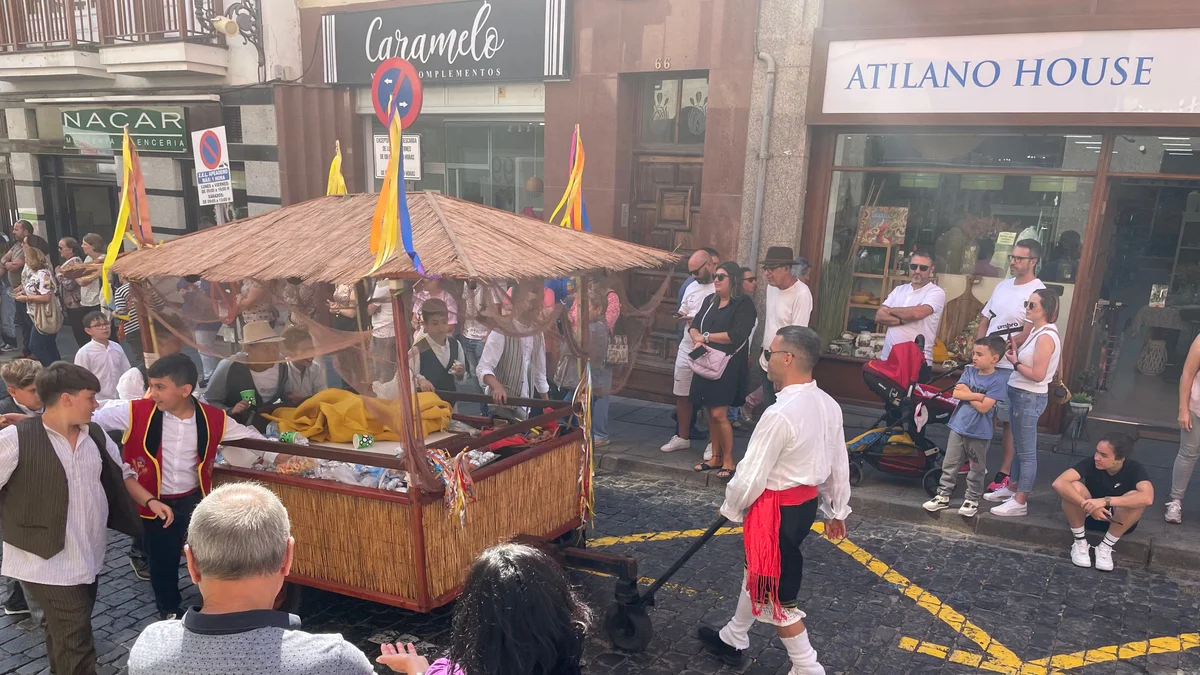
Icod de los Vinos, May 2023
And here comes the part you are not expecting: food and wine are handed down from the carts. Free, including to whoever is standing on the pavement. Bread, cheese, meat, sometimes a cup of wine, passed from hand to hand. You do not need to belong to anything. Standing there is enough.
This is the moment when you feel least like an outsider, and it is where the best photographs happen. The carts move slowly and the whole thing takes an afternoon.
Bring cash. At the stalls, which are called ventorrillos, the beer and the sandwich cannot always be paid for by card in the hill villages, and the nearest cash machine can easily be ten kilometres away. This is the detail that ruins the most evenings, and it is solved by one stop before you set off.
One more practical thing: romerías usually set off in the afternoon, and by then the village is full. If you drive, expect to park on the edge and walk in.
On the coast there is another version. In fishing villages the procession does not head uphill, it heads onto the water: the image is loaded onto a boat and carried out of the harbour, followed by every vessel the village can muster. This is called a romería marinera, and watching an entire flotilla sound its horns on the way out of a harbour belonging to a village of forty people is not something you forget.
Baile de magos: where "mago" is not a magician
This is one of the nicest gifts Canarian Spanish has to offer. Here mago means a country person, someone in traditional rural dress, and has nothing to do with magic. A baile de magos is therefore a dress dance: people come out to dance in Canarian traditional clothing, often whole families, from grandparents to children.
As a visitor you can walk in without a costume and nobody will look twice. But once you see a square full of that clothing, you understand that it is not a stage set. It is the island's own wardrobe.
The music here is traditional: timple, guitar, a chorus. This is not the dance where the summer hits get played.
Verbena: the open-air night dance
This is the loud end of it. A verbena is an open-air dance with live music, and the orquesta is a full band that plays the whole night, covers, Latin, anything you can dance to. It does not really get going before midnight, and it runs until dawn.
The honest part: if you are sleeping nearby, this is not atmosphere, it is noise until three in the morning. In exchange, if you are in it, this is the happiest night the islands will give you, and half the village is there with their children. It is not a nightclub. It is a village dance where everyone from five to eighty is still up.
Carnival: a different season, not a summer plan
This one sits outside the list, so just so you know: carnival is not in summer but in winter, between February and March, before Lent begins. The two big ones are Santa Cruz de Tenerife and Las Palmas de Gran Canaria, but the smaller towns have their own, and the islands stagger their dates, so on a longer trip you can catch two.
In other words, if you come in summer you will not see carnival. What you will see are the four above.
> Did you know? The patron saint of the Canary Islands is the Virgin of Candelaria, and her basilica stands on the east coast of Tenerife, in the town of Candelaria. Many people walk to her mid-August feast, crossing the mountain, setting off at night.
Where the islands genuinely differ
The five words above mean the same thing on all eight islands. There are two things, though, where the islands really do differ, and both affect when and where it is worth going.
The first: every island has its own big one. On Gran Canaria, the Fiesta de la Rama in Agaete, where people carry green branches down to the sea, dancing behind the band. On Lanzarote, the Virgen de los Dolores, which the island connects to the eighteenth-century eruptions. On Fuerteventura, the Virgen de la Peña, the island's patron, in an inland valley. And so on, island by island.
What all of them share: the Virgen del Carmen, in July. She is the patron saint of fishermen, so she is celebrated in practically every coastal village on all eight islands. This is the day you see the seagoing version described above, and it is the best way in for anyone who is only ever going to see one Canarian fiesta.
The second difference matters more, because it forces you to plan: not every big fiesta is annual.
El Hierro's largest event, the Bajada de la Virgen de los Reyes, happens every four years. La Palma's Bajada de la Virgen de las Nieves is every five, and the Danza de los Enanos that forms part of it is an institution in its own right. On La Gomera, the Guadalupe bajada is also every five years.
So these are not the "I will come next summer" kind. If one of them appeals to you, check which year it falls in first, and book the flight second. Accommodation on that island fills up months ahead, because people who emigrated come home from all over the world for it.
The rhythm of the year
If you are still deciding when to come, this part is for you.
Winter, at carnival time: carnival. February into March, before Lent. It is the most spectacular and also the most urban: costume parades, street dancing at night, and the biggest crowds of the year.
Early summer: Corpus Christi and the carpets. For this movable feast, several towns cover their streets with carpets made of flowers and coloured volcanic sand. La Orotava is the most famous: the large picture in front of the town hall takes days to build and disappears under a single procession. If you have to pick one thing from the early-summer programme, pick this.
July: the feast of the sea. Around the Virgen del Carmen, coastal villages take their turn one after another, with a procession by boat. If you are staying near the sea, there is a good chance one will be happening in the next village along during your holiday.
Summer, August above all: the month of the patron saint fiestas. Dozens of towns are celebrating at once, on all eight islands, so wherever you are, there is one within half an hour. In mid-August, the Candelaria feast moves the whole archipelago.
Autumn: not over yet. Fiestas continue through September and October, just further apart. In exchange there are fewer people, and the evenings are milder than in July.
One thing worth keeping in mind: accommodation also fills up around the big summer fiestas, especially in smaller villages. If you are building a trip around a particular fiesta, book the bed before the programme.
What the poster does not tell you
We are writing this part because we run into it every week, while filling our own listings.
The printed time is a start, not a promise of punctuality. If the concert is announced for eight, the first note rarely sounds before nine. This is not disorganisation, it is pace. If there is a procession or a mass, however, that begins on time.
Sometimes the most important thing is missing from the poster: which village this is. It is obvious to locals, so nobody writes it down. We regularly work the location back out from the sponsors and the accompanying text.
Programmes contain mistakes. A day may appear in two places, or the weekday may not match the date. When that happens, trust the date.
The real source is the organiser's own page. Not the tourist guide, but the comisión de fiestas Facebook page, because changes appear there first, often on the day. If your whole day depends on one event, it is worth a look before you leave.
What we cannot tell you, and it is better to say so, is how many people will be there on a given night, and whether it will rain. On these islands the weather in the higher inland villages is often completely different from the coastal resorts, which we explain in our guide to the Canarian microclimates. Even in August, take a jumper if you are heading up into the hills.
Where to see what is on right now
This article explains the types, because the types repeat year after year. The dates do not.
So we do not list individual programmes here. Instead we keep the living list, with every fiesta, romería and procession we collect from the eight islands as the organisers announce them.
Festivals and pilgrimages in the Canary Islands. That list updates itself, so it is current on the day you read this too.
If you want to look wider, the full agenda also has concerts, sport and markets. A market, incidentally, is a good plan for the morning after a verbena.
How not to stand there like a spectator
There is no rigid etiquette, but a few things make it all easier.
Arrive before the start time. Not for the show, but for the parking, and because the build-up is the better part: the preparations, the neighbours laying out the tables.
Eat there. Fiesta food is often exactly the home cooking you have been looking for. If you like it, we have written separately about Canarian food and about where to find home cooking on each island.
Take photographs, but do not stand in front of the image during the procession. That is the one moment which genuinely is not a show.
A few words go a long way. Our Canarian dictionary has guagua, papas and mojo in it, and at the stall those will take you further than English.
And if you have not even settled on an island yet, we compare them separately: which Canary Island to choose. Our guides to La Palma and Gran Canaria pick up where this article leaves off.
A fiesta on these islands is not a programme. It is the most important week of the village's year. The fact that you arrived by accident changes nothing, because it is addressed to you as well: the bread comes down off the cart to you too.
The question is rather which one you will find. The one they recommend at the hotel desk, or the one happening fifty metres off the road you drive down every morning.
Sources
Islas Canarias, the archipelago's official tourism site: https://www.holaislascanarias.com/
Gobierno de Canarias: https://www.gobiernodecanarias.org/
Turismo de Tenerife: https://www.webtenerife.com/

